
Hello, dreamers and deep thinkers.
When people think of American accents, they usually imagine something obvious. A thick Boston edge. A deep Texas drawl. A fast New York City snap. Something dramatic. Something easy to point at and imitate.
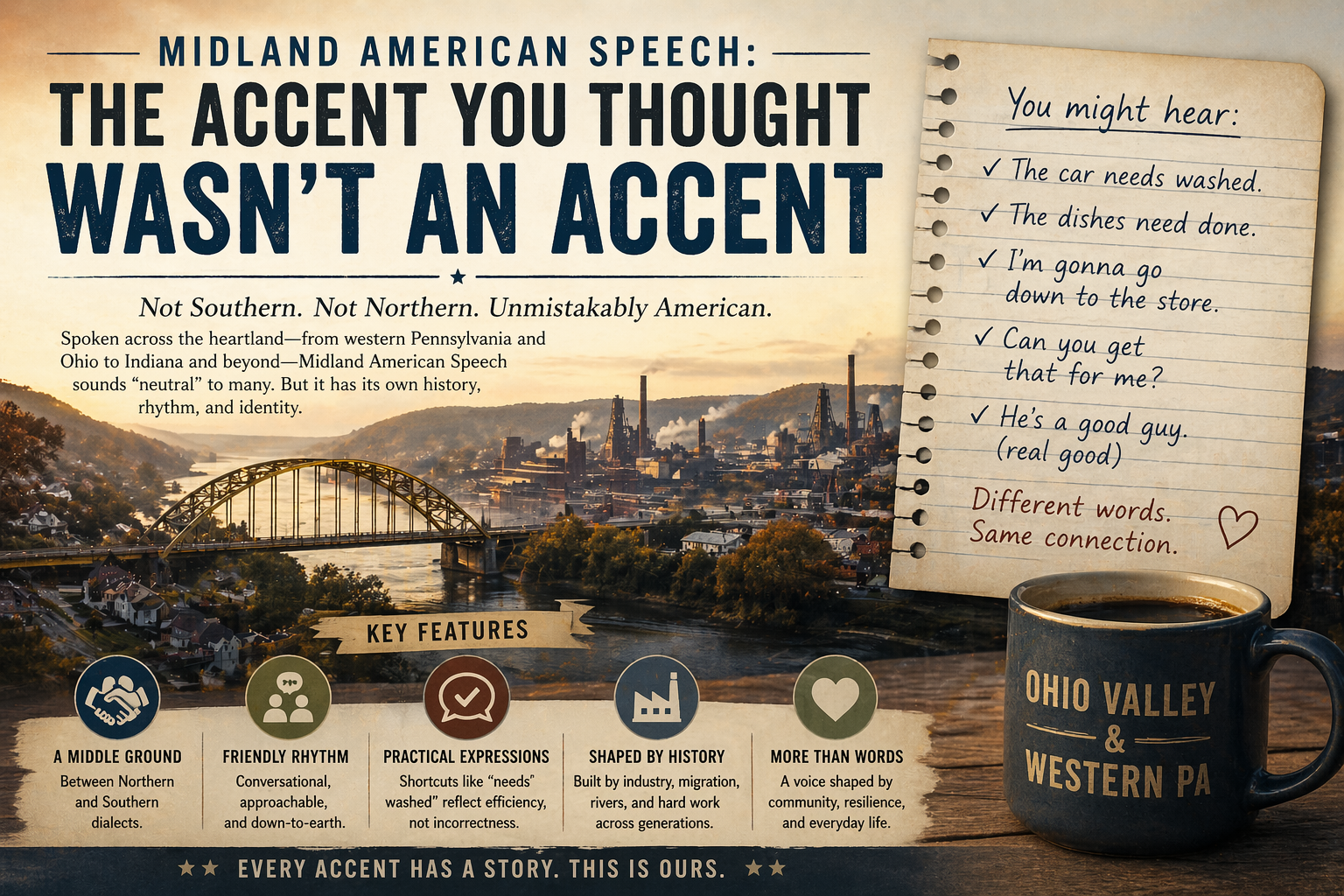
But one of the most influential speech patterns in the United States is often ignored because many people think it sounds like… nothing at all. That dialect is known as Midland American Speech.
It is the accent people mistake for “no accent.” And that misunderstanding says a lot about language, identity, and power.
What Is Midland American Speech?
Midland American Speech is a broad dialect region identified by linguists that stretches through parts of:
- Pennsylvania
- Ohio
- Indiana
- Illinois
- Missouri
- Kansas
- and surrounding areas
It sits historically between Northern and Southern speech zones, making it a kind of linguistic middle ground.
That does not mean bland. It means blended.
Midland speech often carries traces of frontier migration, industrial towns, farming communities, immigrant neighborhoods, Appalachian contact, and practical working-class communication.
The Accent You Don’t Hear
Many Americans hear Midland speech and think:
“This just sounds normal.”
But “normal” usually means familiar, not neutral.
There is no accent-free English. Every speaker has pronunciation habits, vocabulary patterns, rhythms, and grammar structures tied to geography and culture. Midland speech became less noticeable partly because forms of media favored accents that sounded broadly understandable to large audiences.
What people called “standard” was often just widely distributed regional speech with social prestige.
That distinction matters.
The Hidden Music of Midland Speech
Midland American Speech often sounds:
- conversational
- approachable
- steady
- less theatrical than some coastal stereotypes
- less elongated than some Southern stereotypes
- practical and direct
Its rhythm can feel like everyday talk rather than performance. It often carries an understated warmth.
Some dialects announce themselves loudly. Midland speech sometimes slips in quietly and becomes the room’s baseline.
The Famous “Needs Washed”
If you are from western Pennsylvania, eastern Ohio, or parts of the Ohio Valley, you may have heard phrases like:
- The car needs washed.
- The dishes need done.
- The grass needs cut.
Elsewhere, people might say:
- The car needs to be washed.
To outsiders, the Midland version can sound incorrect. To locals, it sounds efficient, natural, and completely ordinary.
Language is full of these shortcuts. Grammar is often just habit that won enough votes.
Why This Matters Psychologically
Speech is identity wearing sound.
The way a person talks often reveals:
- where they grew up
- what class environment shaped them
- who they trust
- what communities they belong to
- what parts of themselves they hide or soften
Many people from Midland regions learn to code-switch without realizing it. They may flatten local phrases in professional settings, then slip back into regional speech with family.
That tells us something deeper: people often edit themselves to be accepted.
The Ohio Valley and Western Pennsylvania Blend
In areas around Pittsburgh, East Liverpool, Beaver Falls, Steubenville, and nearby towns, Midland speech often mixes with:
- Appalachian features
- industrial-era slang
- immigrant language influence
- Pittsburgh vocabulary
- rural speech carryovers
This creates something richer than a neat label. It creates a lived accent shaped by mills, rivers, highways, layoffs, resilience, humor, and family kitchens.
You can hear history in a sentence.
Words as Regional Fossils
Some words survive in one area long after disappearing elsewhere.
Examples include:
- jagoff
- slippy
- redd up
- crick
These are not mistakes. They are cultural fossils.
Every unusual local phrase is proof that language does not move in a straight line. It branches, lingers, mutates, and survives in pockets.
Just like people.
Why Some Accents Get Mocked
Accent judgment is rarely about sound alone. It often hides judgments about:
- education
- class
- region
- politics
- perceived intelligence
- urban vs rural identity
A polished speaker may be assumed competent. A rural speaker may be underestimated. A working-class accent may be treated as less sophisticated.
This is social bias dressed up as linguistic preference.
Midland speech sometimes escapes ridicule because it is less obvious. But many of its local variants still carry class-coded assumptions.
The Myth of “Talking Correctly”
There is useful communication, and there is snobbery. They are not the same thing.
Yes, context matters. Clear speech can be important professionally. But the idea that one regional dialect is inherently superior is not science. It is status behavior.
Language changes because humans change.
Today’s “wrong” can become tomorrow’s accepted usage.
What Midland Speech Symbolizes
To me, Midland American Speech represents something larger in the American psyche:
- the middle spaces
- the overlooked towns
- the workers who keep systems moving
- the people who don’t advertise their depth
- the culture mistaken for ordinary because it is foundational
Some of the most influential things in life become invisible through familiarity.
Air. Water. Labor. Love. Accent.
A Personal Reflection
Many people spend years trying to sound like somewhere else.
More polished. More urban. More elite. More impressive.
But there is dignity in sounding like where you came from.
Your vowels may carry grandparents. Your phrasing may carry neighborhoods. Your cadence may carry factory shifts, church dinners, front porches, and survival humor.
Sometimes the voice we try to outgrow is the map back home.
Final Thought
Midland American Speech is not the absence of accent. It is the presence of a history so common it became easy to overlook.
And that happens to people, too.
Some souls are mistaken for ordinary simply because they are steady, familiar, and woven into daily life.
Do not confuse quiet influence with lack of importance.
Stay curious.


