Hello dreamers and deep thinkers,
Sometimes I stop in my tracks and realize just how lucky I am — how lucky we all are — to be alive in this particular moment of history. Especially for someone like me who has so many questions wondering around in her head.
It’s easy to take it for granted, scrolling through screens or asking questions and receiving answers in seconds. But when you step back, the truth is breathtaking: we are living in an age of information unlike anything humanity has ever known.
A World That Once Guarded Knowledge
For most of human history, knowledge was not free. It was precious, hoarded, even sacred.
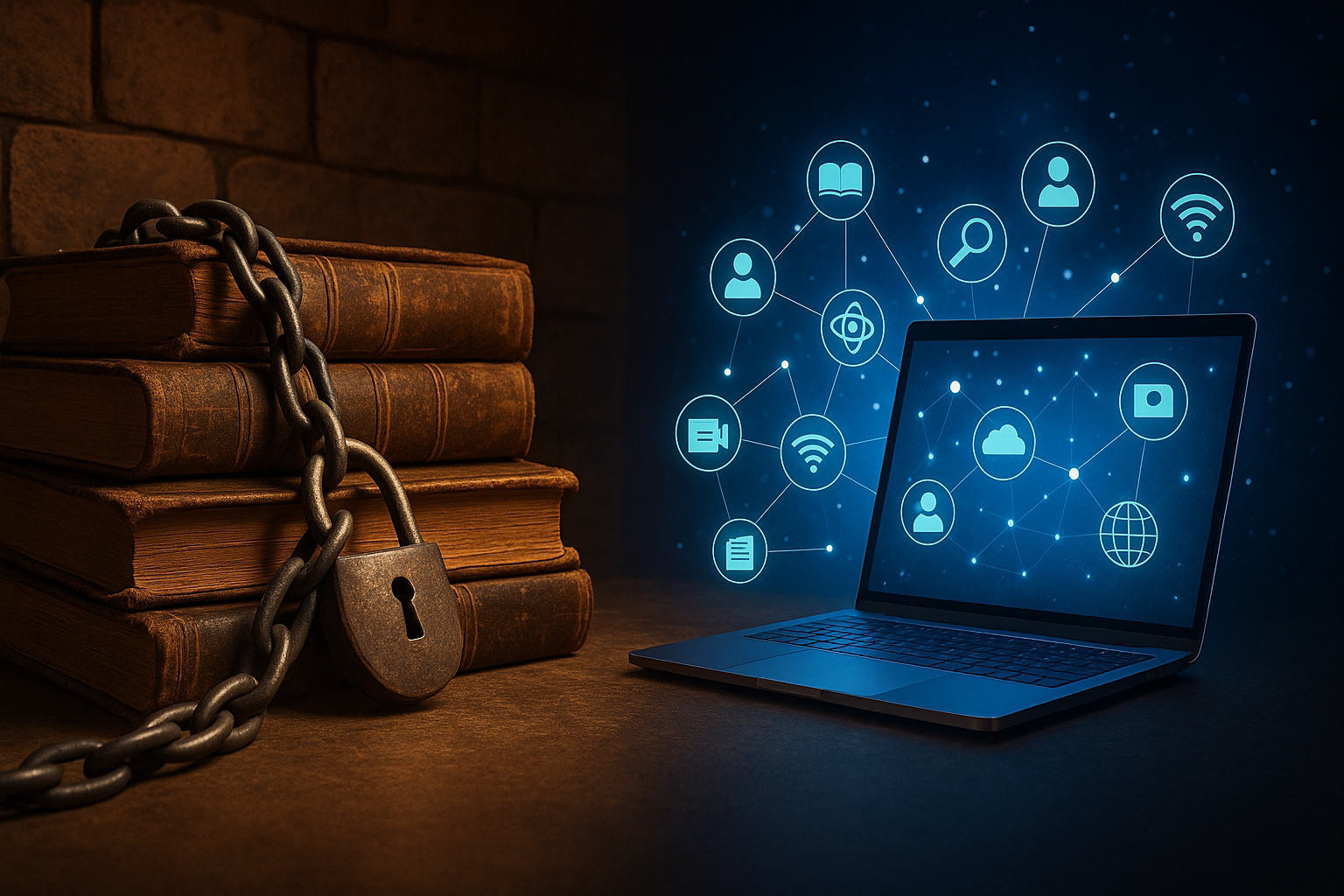
- In the Middle Ages, books were copied by hand and chained to monastery walls. Only the clergy and elites could read them.
- Even after Gutenberg’s printing press in the 1400s, books remained expensive treasures, accessible only to those with wealth or influence.
- For centuries, most people learned just enough to work, fight, or pray. Childhood education was limited, fragmented, and often unavailable to girls, the poor, or those outside the ruling class.
Imagine living in a world where a single book might take years to produce — and you’d never be allowed to touch it.
The Long Road to Education for All
Slowly, the tide turned. The Reformation demanded that every person read the Bible. The Enlightenment insisted that all humans could reason. Revolutions in America and France declared education a right of citizens. By the 1800s and 1900s, compulsory schooling laws began to spread across Europe and America.
And yet, even then, what children received was basic. Literacy was taught, but access to deeper learning was still shaped by class, gender, and geography. Your future was determined by where you were born and who your parents were
The Miracle of the Information Age
Now, here we are — living in a reality that would have seemed like magic to our ancestors.
- We can read. Literacy is no longer a rare privilege but a universal expectation.
- We can learn. The world’s greatest teachers and libraries are available to anyone with an internet connection. Harvard lectures, ancient texts, cutting-edge science — all within reach.
- We can share. Not only do we consume knowledge, we create it. Every thought we publish can circle the globe in moments.
The barriers of class, gender, and geography have been shattered in ways past generations could only dream of.
Gratitude for This Moment
I sometimes imagine my ancestors — working in fields, fighting wars, surviving scarcity — and wonder what they would think if they could see me now: scrolling through a vast, endless library of human knowledge. Would they even believe it was real?
We are the first generations to live in a world where any question can be asked, and often answered, in seconds. Where learning is not dictated by wealth or privilege, but by curiosity. Where the child of a farmer, a factory worker, or a seamstress has the same access to Einstein, Shakespeare, and Sagan as the wealthiest elite.
That is extraordinary.
A Responsibility Too
But fortune comes with responsibility. To honor this gift, we can’t remain passive consumers. The Information Age asks us to think, question, and create. To add our voices to the conversation of humanity. To take the knowledge we inherit and transform it into wisdom that helps others.
For me, that’s what Cognitive Psycho is about: exploring, questioning, and connecting ideas across psychology, philosophy, and the mysteries of existence. It’s my way of honoring the privilege of living in this era — by using it to learn and to share.
So yes, I am fortunate. We are fortunate. Born into a time when the boundaries of class no longer fence in our curiosity, when knowledge flows as freely as water. And the best part? We can carry this fortune forward, ensuring that the next generation not only inherits access to knowledge, but also the wisdom to use it well.
Stay curious,
April
📊 Facts & Statistics on Literacy and Education
Historical Context
- Before 1800, global literacy rates are estimated to have been below 20%. The majority of people lived and died without being able to read.
- Scotland (1700s): Among the first regions with widespread literacy due to parish schools, reaching rates of 65–75% of men by 1750.
- Prussia (1700s): The first state to introduce compulsory primary education (1763), setting the model for modern schooling worldwide.
The 19th–20th Centuries
- By 1900, world literacy had risen to roughly 21%, with enormous gaps between regions (Europe ahead, Africa and South Asia lagging far behind).
- In the U.S. (1870), about 80% of white adults were literate, compared to only 20% of Black adults, reflecting the legacy of slavery and systemic inequality.
- By 1950, world literacy reached around 56%, fueled by post-war education reforms and the spread of compulsory schooling.
Today’s Numbers
- Global literacy rate (2025): Roughly 87% of adults can read and write. That’s the highest in all of human history.
- Youth literacy (ages 15–24): Around 92% worldwide, showing that access to education is improving fastest for younger generations.
- Gender gap closing: In 1970, only 65% of women worldwide were literate; today it’s about 84%, compared to 90% for men.
- Regional differences: Literacy is nearly universal in Europe, North America, and East Asia (>95%), but still below 70% in some parts of sub-Saharan Africa.
Education Beyond Literacy
- Average years of schooling (global): In 1950, the world average was 3 years; by 2020, it had risen to 8 years.
- College enrollment: In 1970, only about 10% of the world’s youth enrolled in higher education. Today, that number is closer to 40%.
- Digital access: Over 5 billion people now use the internet — making it the most powerful tool for education in history.
✅ The Big Picture: In just 200 years, humanity has gone from a world where most people couldn’t read to a world where most people can access an infinite library of information.
What interesting thing did you learn today? Share with me in the comments!