Hello dreamers and deep thinkers,
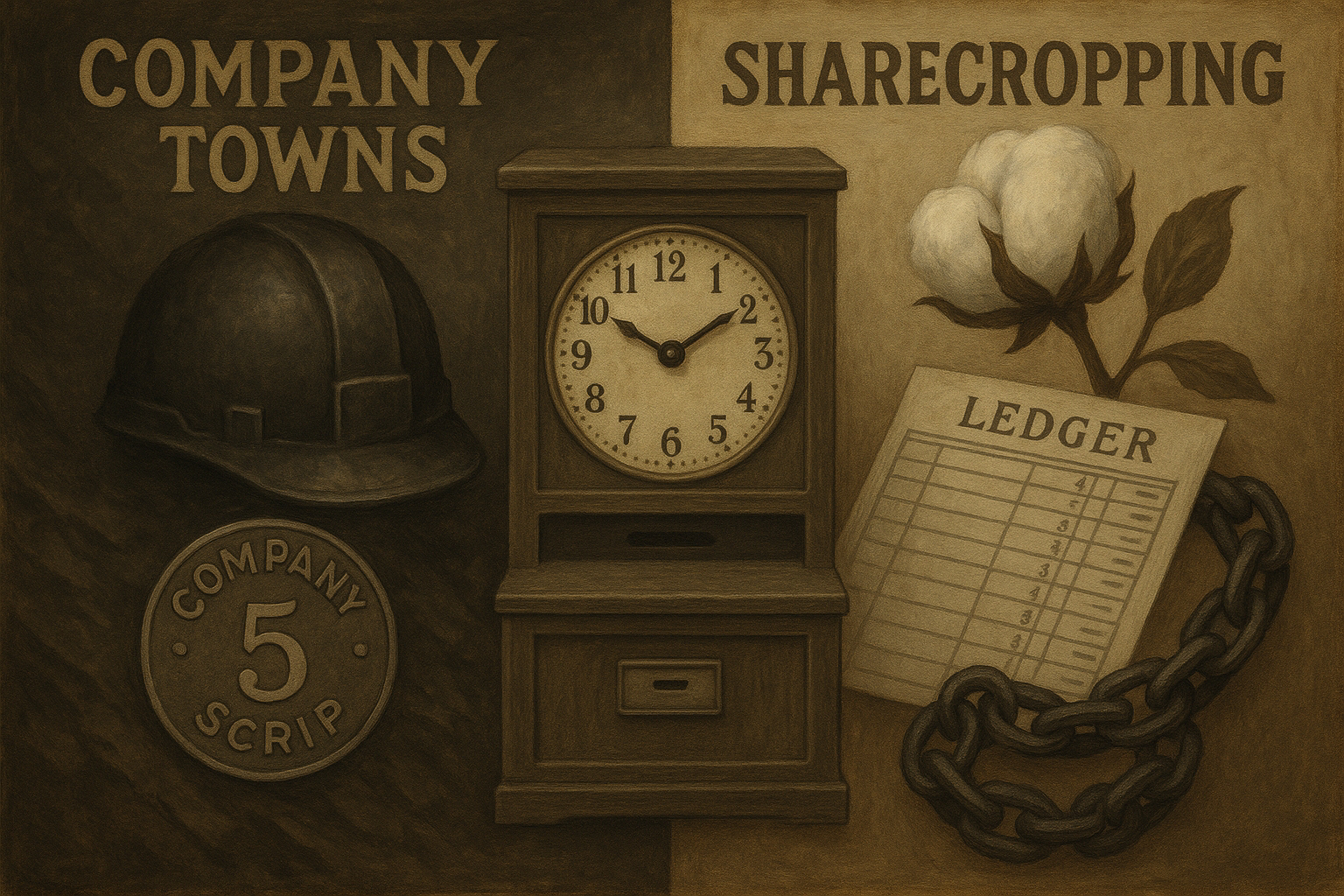
History often reminds us that when one form of control ends, another rises in its place. After the Civil War ended in 1865, the United States entered a new era where slavery was formally abolished, but new systems appeared that kept people trapped in cycles of labor and debt. In the South, sharecropping emerged by the late 1860s and lasted well into the mid-20th century. In the industrial North and West, company towns flourished from the 1880s into the 1930s. Though rooted in different industries, both systems used dependency and debt to control human lives.
Sharecropping: The Aftershock of Slavery (1865–1940s)
When slavery ended, many freed Black families dreamed of “40 acres and a mule,” but that promise never came. Instead, they entered contracts with white landowners under the system of sharecropping. By the 1870s, this became the dominant agricultural labor model in the South.
Under sharecropping:
- Families farmed land they didn’t own, paying rent with a “share” of the crop—often half or more.
- Landowners supplied seeds, tools, and credit but kept the books, often dishonestly.
- Illiteracy, racial violence, and Black Codes left freed people with little recourse.
A poor harvest meant carrying debt into the next year. By the 1880s, entire generations of Black families—and some poor white families—were bound to land they didn’t own. Even into the 1930s and ’40s, sharecropping remained entrenched, only declining as mechanization spread and migration northward accelerated.
Company Towns: Industrial Bondage (1880s–1930s)
As industries like coal, steel, and lumber expanded into remote areas, companies built entire towns to house their workers. By the 1880s, these company towns spread across Appalachia, the Midwest, and the West.
In company towns:
- Employers owned housing, schools, stores, and even churches.
- Workers were often paid in scrip (company-issued tokens) redeemable only at the company store.
- Prices were inflated, wages low, and debts common—leaving families with little chance to save or escape.
This system peaked in the early 20th century, fueling strikes like the Colorado Coalfield War (1913–14) and the Battle of Blair Mountain (1921)—some of the largest labor uprisings in American history. By the 1930s, reforms and unionization began breaking the company town model, though echoes of it lingered.
Parallel Systems, Different Shadows
Though different in setting—fields versus mines—sharecropping and company towns operated on the same principle: freedom on paper, bondage in practice. Both:
- Kept workers tied through debt and dependency.
- Created the illusion of choice while controlling every aspect of survival.
- Maintained a rigid hierarchy of power.
But here is where sensitivity matters:
- Sharecropping was deeply racialized, tied directly to slavery’s aftermath and the rise of Jim Crow laws. For Black families, it wasn’t just economic bondage but also racial oppression.
- Company towns exploited a mix of immigrants, poor whites, and working-class families, but without the same racialized legacy of slavery.
To flatten these systems into one would erase the lived trauma of sharecropping. But to study them side by side reveals how economic structures—whether racial or industrial—replicate control.
The Human Lesson
These systems remind us that exploitation is adaptable. Slavery ends, but the logic of control does not—it shifts form. Whether in cotton fields or coal mines, the human cost was generations of laborers tethered to forces far larger than themselves.
My mother once told me, with sharp certainty, “You don’t hate anything. You may dislike something, but you don’t hate.” It makes me wonder: what if greed is the true root we should learn to hate? Because greed, dressed up as opportunity, has always been the silent architect of cages.
Closing Thought
Company towns and sharecropping were not the same, but they were siblings in the lineage of control. Both teach us that freedom is never just declared—it must be defended, expanded, and reimagined in every generation.
Stay curious.