Imagine strolling through a city where pharaohs once prayed, queens once ruled, and temples still whisper the stories of gods. That’s Luxor, often considered the oldest continuously inhabited city on earth. Unlike most ancient capitals that crumbled into ruins, Luxor never stopped breathing. Today, it’s both a bustling modern Egyptian city and a living museum of human civilization.
A City Where Past and Present Collide
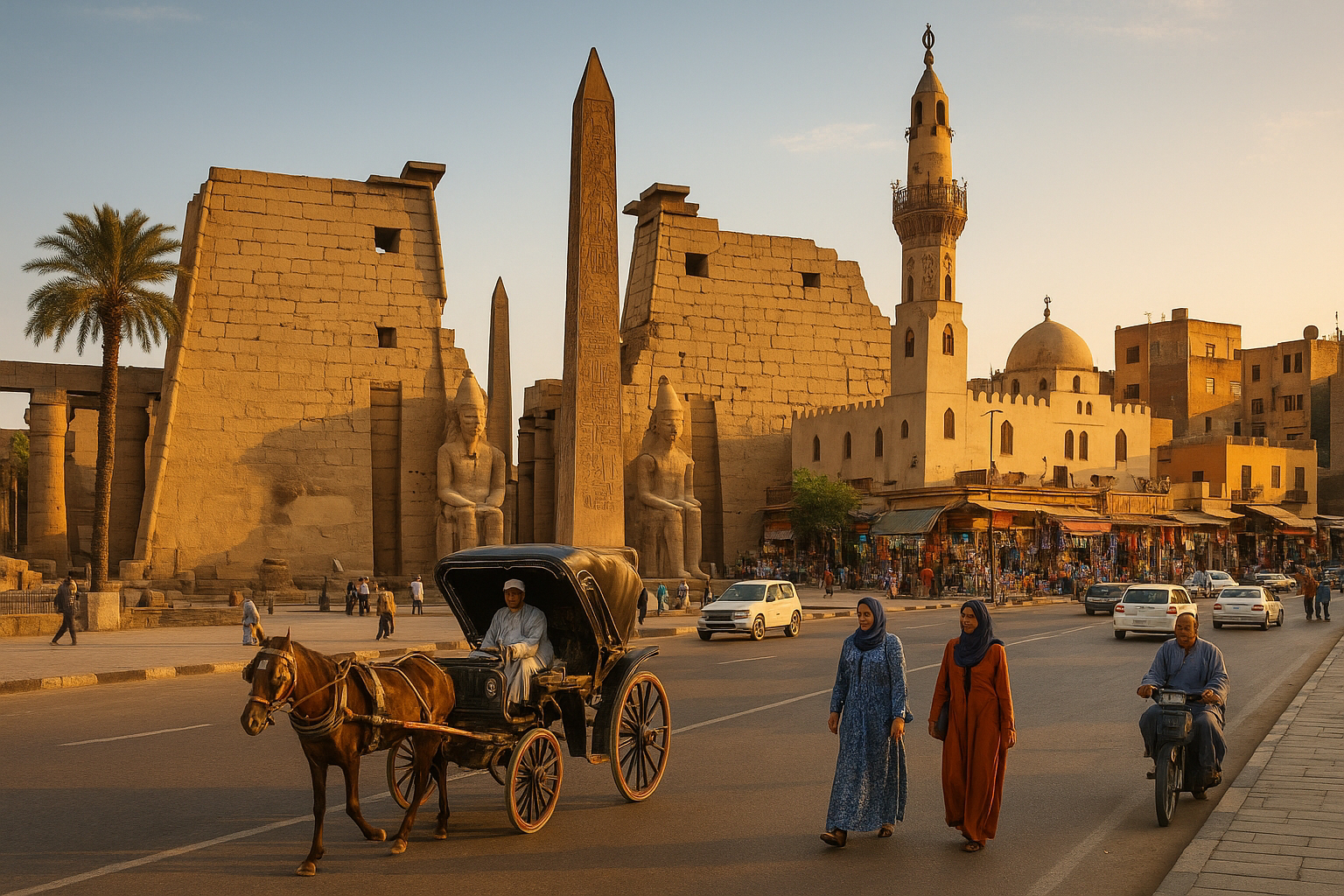
Luxor sits along the Nile, glowing with sandstone temples, towering statues, and sprawling tombs. Locals go about their daily lives—commuting to work, selling spices in the souks, riding mopeds down narrow streets—while just across the river, the Valley of the Kings holds the eternal resting place of Tutankhamun.
This dual identity is what makes Luxor unique. It’s not just about history; it’s about continuity. Fishermen still cast their nets on the Nile, as their ancestors did thousands of years ago. Farmers still irrigate their fields with water from the river, though diesel pumps have replaced the old shadufs (hand-operated water lifters).
Society Then and Now
In ancient Thebes (as Luxor was once called), society revolved around religion and the state. Priests of Amun held immense power, rivaling even the pharaohs. The city was a place of pilgrimage, ritual, and political authority.
Today, Luxor is more grounded in tourism and everyday Egyptian life. Society here is a blend of tradition and modernity. Many families live in tight-knit communities where hospitality and respect for heritage remain strong values. Yet, smartphones, satellite TV, and international influences also shape daily life.
Religion, too, has shifted. Ancient Egyptian polytheism gave way to Christianity in the early centuries, then to Islam around the 7th century. Now, Luxor’s skyline is dotted with mosques, and the rhythm of life often follows the call to prayer.
How Luxor Has Changed
- Architecture: What were once sacred temples are now archaeological parks. The Karnak Temple complex still stands proudly, but it no longer functions as a religious center—it’s a window into the past. Meanwhile, modern Luxor has hotels, cafés, and apartment blocks standing side by side with ancient ruins.
- Economy: Ancient Luxor thrived as a religious capital and trade hub. Today, it thrives mostly on tourism. Visitors come from around the world to experience the grandeur of Egypt’s past, making tourism the lifeblood of the local economy.
- Population: Ancient Thebes may have been home to tens of thousands, but modern Luxor is a city of nearly half a million people. Its residents juggle the demands of modern urban life with the responsibilities of preserving a world heritage site.
- Cultural Identity: What hasn’t changed is Luxor’s sense of pride. Whether in pharaonic times or today, Luxor has always been a city deeply conscious of its importance in the story of humanity.
A Living Legacy
Walking through Luxor feels like stepping through a time portal. You can sip mint tea in a café while looking at temples built 3,000 years ago. You can ride a horse-drawn carriage past walls etched with hieroglyphs that speak of gods, kings, and cosmic order. And you can meet locals whose lives, though modern, still echo with the rhythms of the Nile.
Luxor isn’t just an ancient city—it’s proof that civilization doesn’t always die; sometimes it adapts, evolves, and carries its soul across millennia.