
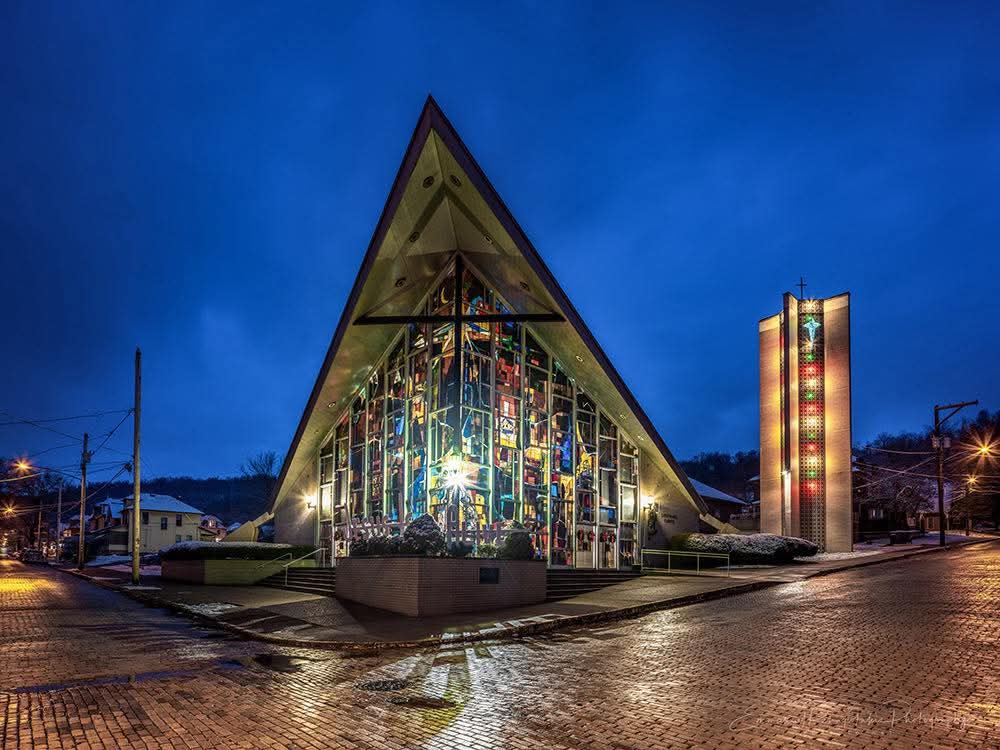
The funeral Mass for Kathleen Galloway (née Dunlap) was held at St. Blaise Roman Catholic Church in Midland, Pennsylvania—a place deeply woven into her life. It was here that Kathleen married her husband, Timothy Galloway, and here that all three of her children (April, Timothy III, and Cassandra “Kc”), were baptized. Returning to this sacred space for her final farewell gave the service a profound sense of homecoming.
The ceremony was led by Father Naugle, who guided family and friends through the rituals of the Catholic Church—each one layered with symbolism and tradition.
The Reception of the Body
The service began at the doors of the church, where Kathleen’s casket was sprinkled with holy water, recalling her baptism. A large white cloth called a pall was then placed over the casket. This pall is a sign of baptism’s promise—that in Christ, we are clothed in eternal life. For those who grew up Catholic, this gesture is both familiar and comforting; for those outside the faith, it is a reminder that death is not an ending, but a return to the promises made at baptism.
The Procession and Liturgy of the Word
As hymns were sung, the casket was carried to the front of the church, placed before the altar. The service moved into the Liturgy of the Word: readings from Scripture, including Old and New Testament passages, were proclaimed. These readings spoke of God’s love, mercy, and the hope of resurrection. A psalm was sung by the cantor, and then Father Naugle read a Gospel passage.
His homily followed, personal and compassionate, reflecting on Kathleen’s life, her faith, and the consolation of Christ’s promise of eternal life. He spoke words meant to comfort her family in their grief, while also pointing them toward hope.
Prayers of the Faithful
Next came the Prayers of the Faithful—petitions lifted up for Kathleen’s soul, for her family, and for the healing of all who mourned. The community responded together, offering their voices as one.
The Liturgy of the Eucharist
The heart of every Catholic funeral Mass is the Eucharist, a sacred meal that Catholics believe is the real presence of Christ. Bread and wine were brought to the altar, prayed over, and consecrated. Family, friends, and parishioners were invited to receive Holy Communion. For Catholics, this act connects the living and the dead—the faithful on earth joining their prayers with the communion of saints in heaven.
Final Commendation
After Communion, the Mass moved into the Final Commendation, the Church’s prayer of farewell. Standing before the casket, Father Naugle prayed that Kathleen be received into God’s arms. He blessed her casket once more with holy water and incense—the water recalling her baptism, the incense rising like prayers to heaven.
A hymn of farewell was sung. It is both a goodbye and a blessing, entrusting Kathleen to God’s care.
The Procession to Burial
Finally, the casket was carried from the church in procession, accompanied by the prayers and hymns of the congregation. Family and friends followed, and Kathleen was laid to rest in Beaver Cemetery and Mausoleum, surrounded by loved ones.
Meaning and Memory
For those who were not Catholic, the service might have seemed rich in ritual—but for Kathleen’s family, it was a deeply personal passage. Every step—the sprinkling of holy water, the readings, the Eucharist, the incense—was a reminder of her life of faith and her place in the larger story of the Church.
That she received her final farewell in the same church where she married, and where her children were baptized, gave her funeral a circle of completion. St. Blaise was not just a parish building—it was the backdrop of her family’s most sacred milestones, and in the end, the place where her life was honored and commended to God.


